5 Ways Dairy Cow Management Software Actually Revolutionizes Your Farm in 2026
Evaluate dairy cow management software to improve herd records, milk tracking, task planning, and decisions across your commercial dairy farm.
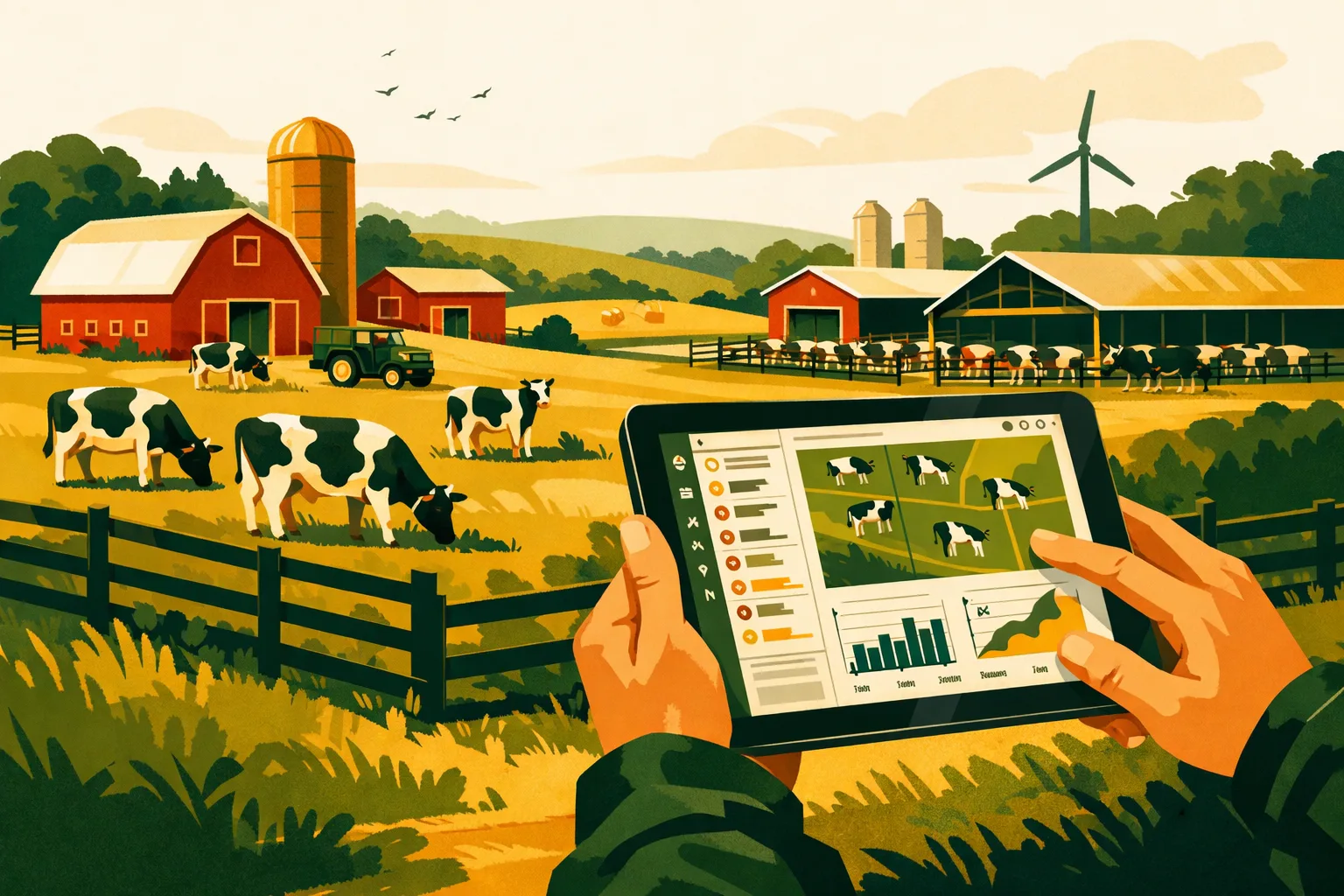
Margins in dairy are won or lost in the gaps: a missed heat, a late treatment, feed changes that do not get tied back to milk response, a maintenance issue that slows the parlor, or records that take too long to pull when a buyer, vet, lender, or inspector asks for them. On a commercial dairy, better software is not about “going paperless” for the sake of it. It is about making the right work visible early enough to act.
Dairy cow management software has moved from simple record storage into daily operating infrastructure. For 50-cow dairies scaling up, multi-site operations, and crop-and-livestock farms running thousands of acres, the right platform can connect herd events, milk production, labor, inventory, field work, compliance, and cost control into one operating view.
Below are five practical ways modern dairy management platforms change farm operations, what to look for when buying, and how to implement software without disrupting your crew.
What Dairy Cow Management Software Should Do in 2026
At minimum, dairy cow management software should help you track individual animals, herd groups, production, reproduction, treatments, culling, inventory, labor tasks, and reporting. For commercial operations, the stronger systems go further by connecting barn-level work with the rest of the farm business.
That matters because dairy operations are rarely “just dairy.” Many farms manage silage acres, manure applications, equipment fleets, feed inventories, employees, contractors, compliance records, and financial decisions alongside the herd.
A practical dairy management system should support:
- Individual cow and group records
- Breeding, pregnancy, calving, and dry-off tracking
- Health events, treatments, withdrawals, and vet protocols
- Milk production and quality data
- Feed inventory and ration-related records
- Task assignment for employees and managers
- Equipment, parlor, and facility maintenance tracking
- Mobile access from barns, fields, shop, and office
- Reporting for management, lenders, certifiers, buyers, and regulators
- Integration or export options for accounting, milk testing, sensors, and field operations
If your operation also grows feed, your dairy software should work alongside farm management tools. For a broader look at whole-farm systems, see the FarmsFlo guide to farm management software and farm record keeping.
1. It Turns Cow Data Into Daily Management Decisions
The first major shift is moving from historical recordkeeping to active decision support.
Many dairies already collect a large amount of information: milk weights, SCC data, breeding events, vet checks, treatments, calving records, feed changes, culls, and parlor observations. The problem is that data often sits in separate places. One person has the breeding book, another has the treatment clipboard, milk data is in a processor portal, and the manager is building reports manually.
Dairy cow management software brings those records into a system that can support daily action.
From “What Happened?” to “What Needs Attention Today?”
Good software should make priority work obvious when the day starts. Instead of searching through notes, managers should see:
- Cows due for pregnancy checks
- Fresh cows needing observation
- Animals past due for breeding
- Treatment follow-ups due today
- Withdrawal periods that are active
- Cows with declining production trends
- Calving and dry-off schedules
- Group moves that need to happen
- Exceptions by pen, barn, or lactation group
This is where software becomes operational instead of administrative. It helps managers focus labor where it has the highest return.
For example, a herd manager should be able to open a mobile dashboard and see that Pen 4 has six cows due for rechecks, two cows eligible for breeding, and one animal under a milk withdrawal period. That list can be assigned to a specific employee, completed in the barn, and documented immediately.
Better Fresh Cow and Transition Management
Fresh cow management is one of the most record-intensive areas on a dairy. Missed observations and inconsistent documentation can lead to slower intervention, lower production response, and avoidable losses.
Software helps standardize fresh cow workflows by creating repeatable task schedules, such as:
- Day 1 post-calving check
- Temperature monitoring
- Ketosis screening
- Metritis observation
- Appetite and rumination notes
- Treatment follow-up
- Vet recheck
- Move to production group
The benefit is not simply having a record. The benefit is making sure the work happens on time, the same way, across employees and shifts.
Better Reproductive Management
Reproduction programs require timing discipline. Whether your farm uses activity monitoring, visual heat detection, timed AI protocols, or a combination, software helps keep breeding decisions organized.
A useful platform should track:
- Days in milk
- Voluntary waiting period
- Heat events
- Breeding dates
- Sire used
- Technician
- Pregnancy diagnosis
- Open cows
- Cows eligible for synchronization protocols
- Repeat breeders
- Do-not-breed status
- Expected calving dates
This makes weekly reproductive meetings more productive. Instead of compiling lists from multiple records, managers and vets can review current eligibility, problem animals, and upcoming work from the same data source.
Practical Time Estimate
For a commercial dairy, expect the first 2 to 6 weeks of adoption to involve setup, animal imports, employee training, protocol configuration, and workflow testing. Smaller operations may be fully operational faster; larger multi-site farms should plan a phased rollout by barn, herd group, or management function.
Daily use should not add work once established. The goal is to replace duplicate entry, paper forms, and end-of-day transcription with real-time updates.
2. It Connects Herd Health, Treatments, and Compliance
Animal health records are high-risk records. If treatment documentation is incomplete, inaccurate, or hard to retrieve, the farm is exposed to residue risk, audit issues, and management blind spots.
Dairy cow management software helps bring structure to herd health decisions by tying protocols, treatments, withdrawal dates, follow-ups, and vet oversight into one system.
Treatment Records That Hold Up Under Pressure
A farm-scale treatment record should capture:
- Animal ID
- Diagnosis or reason for treatment
- Product used
- Dosage
- Route of administration
- Date and time
- Person administering treatment
- Milk withdrawal
- Meat withdrawal
- Follow-up date
- Vet protocol or authorization
- Outcome
- Notes and attachments when needed
A paper notebook can technically capture this, but it often fails under busy conditions. Software reduces risk by prompting required fields and making withdrawal status visible to the team.
That visibility is critical. A cow under withdrawal should not depend on someone remembering a note from yesterday’s shift. The status needs to be clear in the system and accessible where the work happens.
Standardizing Protocols Across Employees
Commercial dairies often have multiple people administering treatments, moving cows, checking fresh animals, and recording events. Even with a strong team, consistency can drift if protocols live in binders or in one manager’s head.
Software can turn protocols into guided workflows:
- Select condition
- View approved treatment options
- Record required details
- Trigger withdrawal calculation
- Schedule follow-up task
- Alert manager or vet if criteria are met
This does not replace veterinary direction. It supports the farm’s approved protocols and helps employees follow them consistently.
Audit and Buyer Readiness
Milk buyers, processors, animal welfare programs, organic certifiers, lenders, and regulatory agencies may ask for documentation. When records are digital and searchable, you can produce them faster and with more confidence.
Common report needs include:
- Treatment logs
- Withdrawal history
- Mortality and cull records
- Calving records
- Drug inventory records
- Vet protocol documentation
- Employee training records
- Animal movement records
- Milk quality notes
- Corrective actions
For farms that manage broader compliance across crops, manure, equipment, and inputs, a unified record system reduces the scramble. FarmsFlo has related guidance on farm compliance record keeping and farm inventory management.
Cost Consideration
The cost of software should be compared against the risk and labor tied to manual records. Ask vendors whether pricing is based on animal count, users, modules, acreage, or sites. Also ask whether health, treatment, compliance, inventory, and reporting functions are included or charged separately.
Budget for:
- Software subscription or license
- Onboarding and data migration
- Staff training time
- Mobile devices if needed
- Tag readers or integrations if used
- Ongoing support or premium support tiers
The cheapest system is not always the lowest-cost system if it creates duplicate work or leaves compliance gaps.
3. It Improves Feed, Inventory, and Crop-to-Cow Visibility
Feed is one of the largest operating cost areas on a dairy, and it connects directly to agronomy, harvest timing, storage, ration management, labor, and milk response. Dairy cow management software becomes more valuable when it helps connect herd performance to feed and inventory decisions.
Even if ration balancing is done in a specialized nutrition platform, farm management software can still track the operational side: what was harvested, where it came from, where it is stored, how inventory changes, what gets fed, and how those decisions relate to production.
Managing Feed Inventory at Commercial Scale
Feed inventory management can become messy fast when the farm has multiple bunkers, bags, commodity bays, deliveries, and homegrown feeds. Without current inventory records, farms risk last-minute purchases, inaccurate cost projections, shrink that goes unnoticed, and ration changes that are not documented well.
Useful software should help track:
- Corn silage by bunker, field, crop year, and estimated tons
- Haylage, baleage, dry hay, straw, and bedding
- Purchased commodities
- Mineral and additive inventory
- Feed deliveries
- Lot numbers where relevant
- Inventory adjustments
- Usage by group or ration
- Reorder points
- Storage locations
For farms growing their own feed, connecting field records with feed inventory is especially valuable. Field-level records help answer questions such as:
- Which fields produced the silage currently being fed?
- What hybrid, cutting, or harvest window is tied to this inventory?
- Which manure or fertilizer applications were made?
- Which fields should be prioritized next season?
- How should feed cost be allocated across herd groups?
If your operation manages significant acreage, review FarmsFlo’s guides on field mapping software and farm task management for crop-side workflow planning.
Linking Feed Changes to Production Trends
A strong dairy operation wants to know not only what was fed, but what changed after a feed or ration adjustment.
Software can help managers track:
- Date of ration change
- Group affected
- Feed source or bunker change
- Dry matter changes
- Milk response
- Components response
- Health events after change
- Refusals or intake notes
- Weather or heat stress context
- Labor or delivery issues
This does not replace a nutritionist. It gives the nutritionist and farm manager cleaner context.
For example, if milk components dip after switching to a new silage face, the team can quickly see the timing, group, feed source, and related notes instead of relying on memory.
Reducing Inventory Surprises
Commercial dairies do not need software that only reports inventory after the fact. They need alerts and visibility before a problem reaches the feed lane.
Good software should support reorder points or low-inventory warnings for:
- Mineral
- Protein sources
- Calf feed
- Milk replacer
- Bedding
- Treatment supplies
- Sanitation products
- Parlor supplies
- Fuel and shop consumables
This is where dairy management overlaps with whole-farm operations. Feed, animal health, and equipment downtime are all connected through inventory discipline.
Practical Cost and Time Estimate
Initial feed inventory setup may take a day or several days depending on the number of storage sites, historical records, and whether you want field-level traceability. After setup, inventory accuracy depends on consistent updates at delivery, harvest, transfer, and feeding.
A reasonable implementation approach:
- Start with current major feed inventories.
- Add purchased commodities and reorder points.
- Add field source details for homegrown feeds.
- Add group-level usage tracking.
- Review inventory variance monthly.
Trying to build a perfect historical feed database before using the system often delays adoption. Start with the records that affect current decisions.
4. It Makes Labor and Task Management More Accountable
Labor is one of the hardest parts of running a dairy because work is constant, repetitive, time-sensitive, and spread across multiple locations. Software helps by turning recurring work into assigned, trackable tasks.
This is especially useful for farms with multiple shifts, family members, hired employees, part-time labor, contractors, or separate crop and dairy crews.
From Verbal Instructions to Trackable Workflows
On many farms, daily instructions happen through whiteboards, texts, notebooks, radio calls, and quick conversations. That can work until a manager is off-site, a shift changes, or an employee misses context.
Dairy cow management software can centralize tasks such as:
- Fresh cow checks
- Pen moves
- Breeding list
- Vet list
- Hoof trimming list
- Vaccination schedule
- Dry-off list
- Calf feeding tasks
- Parlor wash tasks
- Milk quality checks
- Bedding schedule
- Feed push-up schedule
- Scraping and manure tasks
- Equipment inspections
- Facility repairs
A manager should be able to assign the task, set the due date, attach instructions, and confirm completion.
Better Communication Across Barn, Shop, Office, and Field
Dairy operations are full of handoffs. The feeder sees an intake problem. The milker notices a quarter issue. The herd manager needs a cow pulled. The mechanic needs to know a skid steer has a hydraulic leak. The crop crew needs to know when manure storage capacity is becoming tight.
When those handoffs happen only by memory or text messages, follow-through depends on people being available at the same time.
Software improves communication by keeping notes attached to the work:
- Cow-level notes stay with the animal record
- Equipment issues stay with the asset
- Field tasks stay with the field
- Inventory requests stay with the item
- Employee assignments stay visible to managers
For more on organizing cross-team work, see FarmsFlo’s guide to farm task management software.
Training New Employees Faster
A good task system also reduces training gaps. New employees still need hands-on training, but software gives them structure:
- What needs to be done
- Where it needs to be done
- When it is due
- What protocol applies
- What must be recorded
- Who to notify if there is an issue
This is useful for routine jobs and critical tasks. For example, a new employee assigned to calf health checks can follow a standard checklist rather than relying on memory after one training session.
Accountability Without Micromanagement
The goal is not to monitor employees for the sake of monitoring. The goal is to know whether critical tasks were completed, identify bottlenecks, and reduce preventable misses.
Managers can use task history to answer practical questions:
- Which tasks are frequently late?
- Which employees need additional training?
- Are certain barns understaffed at specific times?
- Are vet check lists prepared before the vet arrives?
- Are parlor maintenance tasks being completed?
- Are recurring repairs being documented or ignored?
- Are seasonal tasks being missed during planting or harvest?
For farms that also manage equipment-heavy crop operations, task accountability is closely tied to maintenance. FarmsFlo’s farm equipment maintenance log guide covers how to keep service records organized at scale.
5. It Gives Owners and Managers a Whole-Farm Operating View
The most transformative impact of dairy cow management software is not one feature. It is the ability to see the dairy as an operating system: cows, crops, people, feed, equipment, compliance, and costs.
Dairy decisions are interconnected. A crop harvest delay affects feed quality. Feed quality affects production. Production affects cash flow. Cash flow affects purchasing. Equipment downtime affects labor. Labor gaps affect cow care. Records affect audits and lender confidence.
Software helps owners manage those connections instead of reacting to them separately.
Dashboard Visibility for Commercial Decisions
A useful management dashboard should show leading indicators and exceptions, not just stored records.
Commercial dairy managers may want views for:
- Herd inventory by group
- Fresh cow alerts
- Reproduction work due
- Open cows and pregnancy status
- Treatment withdrawals
- Milk production trends
- Milk quality issues
- Feed inventory status
- Labor task completion
- Equipment maintenance due
- Field work status
- Compliance records due
- Input inventory levels
- Upcoming purchases or shortages
The right dashboard depends on the operation. A 60-cow dairy with 200 acres does not need the same view as a 3,000-cow dairy with multiple sites and a large forage program. The software should be configurable enough to match the farm’s structure.
Better Meetings With Fewer Spreadsheets
Dairy management meetings are more useful when everyone is working from current records. Software can support:
- Weekly herd meetings
- Vet check planning
- Reproduction reviews
- Nutritionist visits
- Crop and feed planning
- Employee planning
- Equipment maintenance meetings
- Financial reviews
- Compliance preparation
Instead of building reports from scratch, managers can pull current lists and trend views. That saves office time and makes meetings more focused on decisions.
Stronger Decision History
Farm owners make hundreds of operational decisions every month. Without a system, it is difficult to look back and know why something changed.
Software creates decision history:
- When a ration changed
- Why a cow was culled
- Which fields were harvested into which bunker
- When a treatment protocol was updated
- When a machine started having repeat issues
- Why a group move was made
- Which employees handled specific tasks
- When an audit issue was corrected
This history is valuable for managers, advisors, lenders, and future succession planning. If one key employee leaves, the farm should not lose the operating memory of the business.
Comparison: Paper, Spreadsheets, and Dairy Cow Management Software
The right setup depends on farm size, complexity, labor structure, and growth plans. For most commercial dairies, paper and spreadsheets become limiting once records need to be shared, searched, audited, and acted on daily.
| Area | Paper Records | Spreadsheets | Dairy Cow Management Software |
|---|---|---|---|
| Cow-level records | Simple but hard to search and easy to misplace | Searchable but often manually updated | Searchable, structured, and linked to tasks |
| Treatment tracking | High risk of missing details | Better structure but limited alerts | Protocols, withdrawal tracking, follow-ups, reports |
| Reproduction lists | Requires manual updates | Useful if maintained daily | Automated eligibility lists and due tasks |
| Feed inventory | Often estimated | Can work with disciplined updates | Storage locations, usage, reorder points, field links |
| Labor accountability | Relies on verbal follow-up | Limited unless customized | Assigned tasks, due dates, completion history |
| Compliance reporting | Time-consuming to compile | Possible but often fragmented | Faster reporting from centralized records |
| Multi-user access | Limited | Version control issues common | Role-based access across team members |
| Mobile use | Not practical | Possible but clunky | Built for barn, field, shop, and office use |
| Scaling | Breaks down as complexity grows | Requires constant maintenance | Better suited for multi-site and larger teams |
| Management value | Historical documentation | Basic analysis | Daily decision support and operating visibility |
Buying Criteria for Dairy Cow Management Software
Before comparing demos, define what problems you need the software to solve. A system that looks impressive in a demo may not fit your barn workflow, labor structure, or advisory team.
1. Mobile Usability in Real Farm Conditions
The software should work where your employees work. That means barn aisles, calf areas, feed centers, shop, field edges, and office desks.
Ask:
- Can employees record events quickly from a phone or tablet?
- Is the interface usable with gloves or dirty hands?
- Does it support offline or low-connectivity workflows if needed?
- Can users see only the tasks and records relevant to their role?
- Is data entry fast enough to happen during the workday?
If employees cannot use the system easily, managers will end up entering records later, and the value drops.
2. Strong Animal Records and Event Tracking
For dairy operations, cow-level data must be reliable. Ask whether the system supports:
- Animal IDs and tag history
- Lactation records
- Calving events
- Breeding events
- Health events
- Treatments
- Withdrawals
- Group and pen moves
- Cull and death records
- Attachments and notes
- Bulk actions for groups
Bulk actions matter on commercial farms. If it takes too long to record common group events, the system will not be used consistently.
3. Task and Workflow Management
Look for software that turns records into action. A recordkeeping system that cannot assign work will still leave managers chasing people.
Ask:
- Can tasks be recurring?
- Can tasks be assigned by employee, role, barn, field, or equipment?
- Can protocols trigger follow-up tasks automatically?
- Can managers see overdue tasks?
- Can completed tasks feed back into the cow, field, inventory, or equipment record?
4. Reporting and Export Options
The software should make reporting easier, not trap your data.
Ask:
- Can reports be customized?
- Can data be exported?
- Can you filter by date, group, employee, animal, field, or product?
- Can reports support audits and buyer requirements?
- Can advisors access reports with permission?
Your data belongs to your farm. Make sure the platform supports that principle.
5. Integration With the Rest of the Farm
If your dairy also manages acreage, manure, equipment, and inventory, avoid a narrow system that forces you into more disconnected tools.
Ask whether the system can support or connect with:
- Field records
- Crop inputs
- Feed inventories
- Equipment maintenance
- Employee tasks
- Chemical and fertilizer records
- Manure application records
- Accounting exports
- Sensor or parlor data where relevant
One platform does not have to do every specialized calculation, but it should reduce duplicate entry and give managers a connected view.
Practical Implementation Checklist
Use this checklist to roll out dairy cow management software without overwhelming the operation.
Before You Buy
- List the top 5 operational problems you want solved.
- Identify current record sources: paper, spreadsheets, parlor software, vet records, feed records, accounting, inventory.
- Decide who needs access: owners, herd manager, feeders, milkers, calf team, crop manager, mechanic, office staff, vet, nutritionist.
- Define must-have records: treatments, withdrawals, breeding, calving, feed, tasks, inventory, equipment, compliance.
- Confirm pricing structure and total cost by animal, user, module, site, or acreage.
- Ask about onboarding, training, support, and data migration.
- Test mobile workflows with the employees who will actually use the system.
- Confirm export options and data ownership.
During Setup
- Import or enter current animal inventory.
- Clean up duplicate IDs and outdated records.
- Configure groups, pens, barns, and sites.
- Add standard health and treatment protocols.
- Set withdrawal and follow-up requirements.
- Build recurring task lists.
- Add major feed inventories and storage locations.
- Add critical equipment and maintenance schedules.
- Assign user roles and permissions.
- Train employees by job function, not all at once.
First 30 Days
- Start with daily tasks, treatments, breeding, and fresh cow records.
- Review overdue tasks every day.
- Hold a weekly review with managers and key employees.
- Fix workflow problems quickly.
- Avoid building complex reports until data entry is consistent.
- Compare software records against paper backups during transition.
- Phase out duplicate records only after the team is confident.
First 90 Days
- Add feed inventory tracking if not already active.
- Add equipment maintenance and repair records.
- Connect crop records and field-level feed source data where useful.
- Create standard reports for vet, nutrition, compliance, and owner review.
- Review user adoption by employee and role.
- Refine protocols and task templates.
- Remove unnecessary manual spreadsheets.
Common Mistakes to Avoid
Trying to Digitize Everything at Once
A dairy is too complex to rebuild every workflow in one week. Start with high-value records: treatments, withdrawals, reproduction, fresh cows, daily tasks, and feed inventory. Expand once the team is using the system consistently.
Letting Only the Office Use the Software
If records are entered hours or days after the work, accuracy suffers. The system should be used by the people doing the work, with role-based access and simple mobile forms.
Ignoring Employee Buy-In
Employees need to understand what is changing and why. Keep training practical. Show them how the software reduces confusion, missed tasks, repeated questions, and end-of-day paperwork.
Keeping Duplicate Systems Too Long
Temporary overlap is smart during transition. Permanent duplication creates extra work and conflicting records. Set a date to retire old forms once confidence is high.
Buying for Features Instead of Workflows
A long feature list does not guarantee fit. Buy based on the farm’s daily workflow: how cows are checked, how treatments are recorded, how feed is managed, how tasks are assigned, and how managers review results.
How to Estimate Return From Dairy Cow Management Software
Software ROI will vary by herd size, labor structure, current record quality, and how well the system is implemented. Avoid relying on generic claims. Build your own estimate using farm-specific numbers.
Evaluate potential gains in these areas:
Office and Recordkeeping Time
Estimate hours currently spent on:
- Rewriting paper records
- Building vet lists
- Preparing compliance reports
- Updating spreadsheets
- Searching for treatment records
- Reconciling inventory
- Communicating task lists
- Creating management reports
Then estimate how much of that work can be reduced after implementation.
Avoided Errors and Delays
Estimate the cost of:
- Missed breeding opportunities
- Late treatment follow-ups
- Incomplete withdrawal visibility
- Inventory shortages
- Duplicate purchases
- Emergency feed purchases
- Unplanned equipment downtime
- Audit preparation delays
Not every item can be predicted perfectly, but the exercise helps clarify where software has financial value.
Better Management Decisions
Some gains come from making faster decisions:
- Identifying fresh cow problems earlier
- Spotting production changes after feed shifts
- Improving reproduction list accuracy
- Reducing cull decision uncertainty
- Tracking repeated equipment failures
- Improving crop-to-feed planning
These are harder to quantify but often highly valuable in commercial operations.
What 2026-Ready Dairy Software Should Feel Like
The best test is simple: after 60 to 90 days, managers should feel more in control of daily work, not more buried in data.
A 2026-ready system should feel:
- Faster than paper
- Easier than spreadsheets
- Useful from a phone
- Practical for employees
- Reliable for compliance
- Flexible for farm-specific workflows
- Connected across dairy, crops, equipment, inventory, and labor
- Clear enough for owners to make decisions
If a platform only stores data but does not help run the farm, keep evaluating.
How FarmsFlo Helps
FarmsFlo is built for commercial farm operations that need practical, connected management tools across livestock, crops, labor, equipment, inventory, and records. For dairy farms, that means fewer disconnected spreadsheets, clearer daily task management, stronger recordkeeping, and better visibility across the whole operation.
With FarmsFlo, your team can organize farm work, centralize records, manage tasks, track inventory, coordinate field and facility operations, and keep managers aligned from barn to office. Whether you run a growing dairy with feed acres or a larger multi-site operation, FarmsFlo helps turn daily farm activity into usable operating data.
If you are evaluating dairy cow management software for 2026, start with the workflows that cost you the most time: treatments, tasks, feed inventory, equipment maintenance, and reporting. Then see how FarmsFlo can help your team manage them in one place.
Start a FarmsFlo trial at farmsflo.com and see how a more connected farm management system can fit your dairy operation.